5 Flatfish Rigs for Shore Fishing

Discover five effective flatfish rigs for UK shore fishing, including the running wishbone, running ledger, two-hook rig, pulley rig and Wessex rig, with tips on when and where to use each one.

7 September 2026 · 8 min read
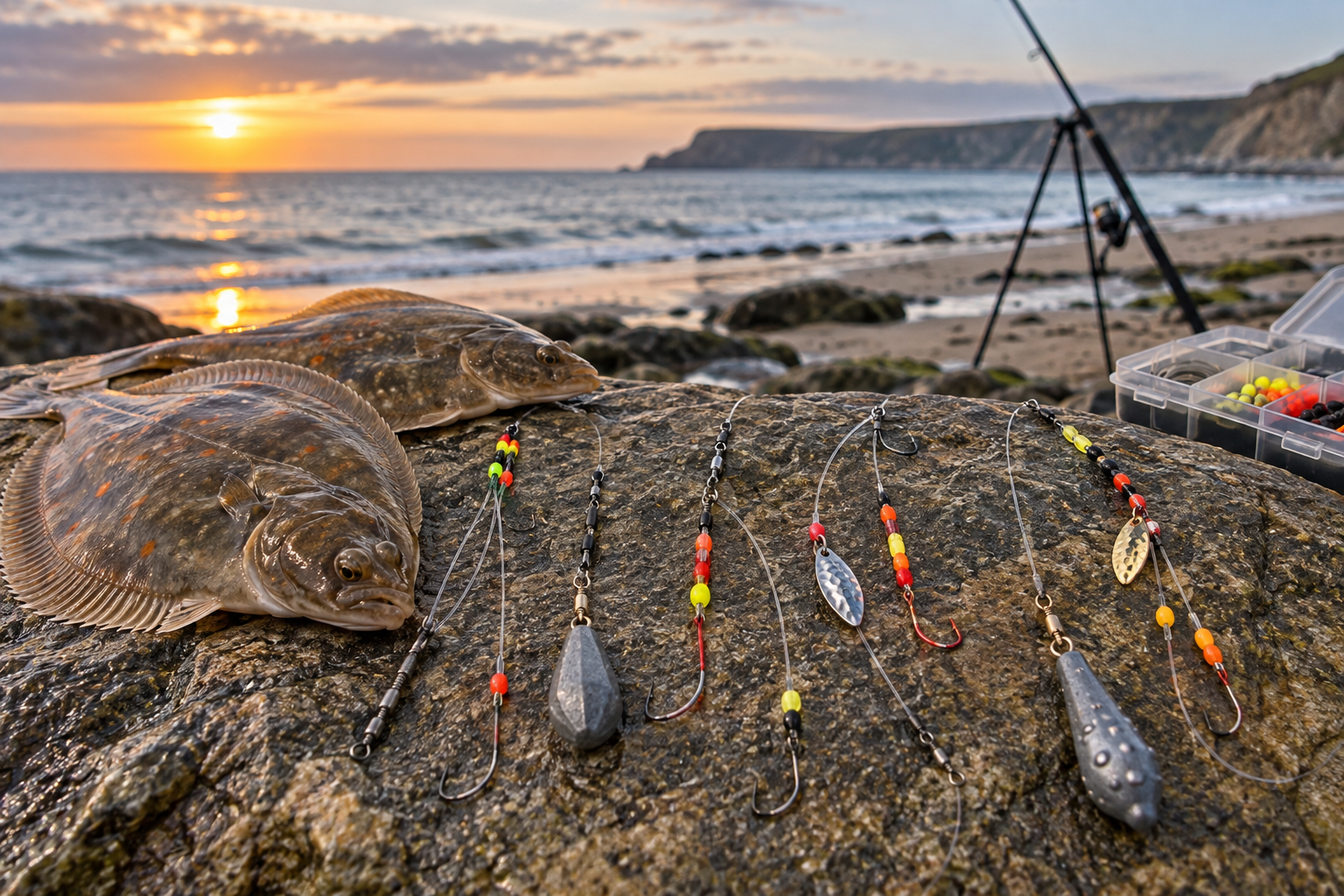
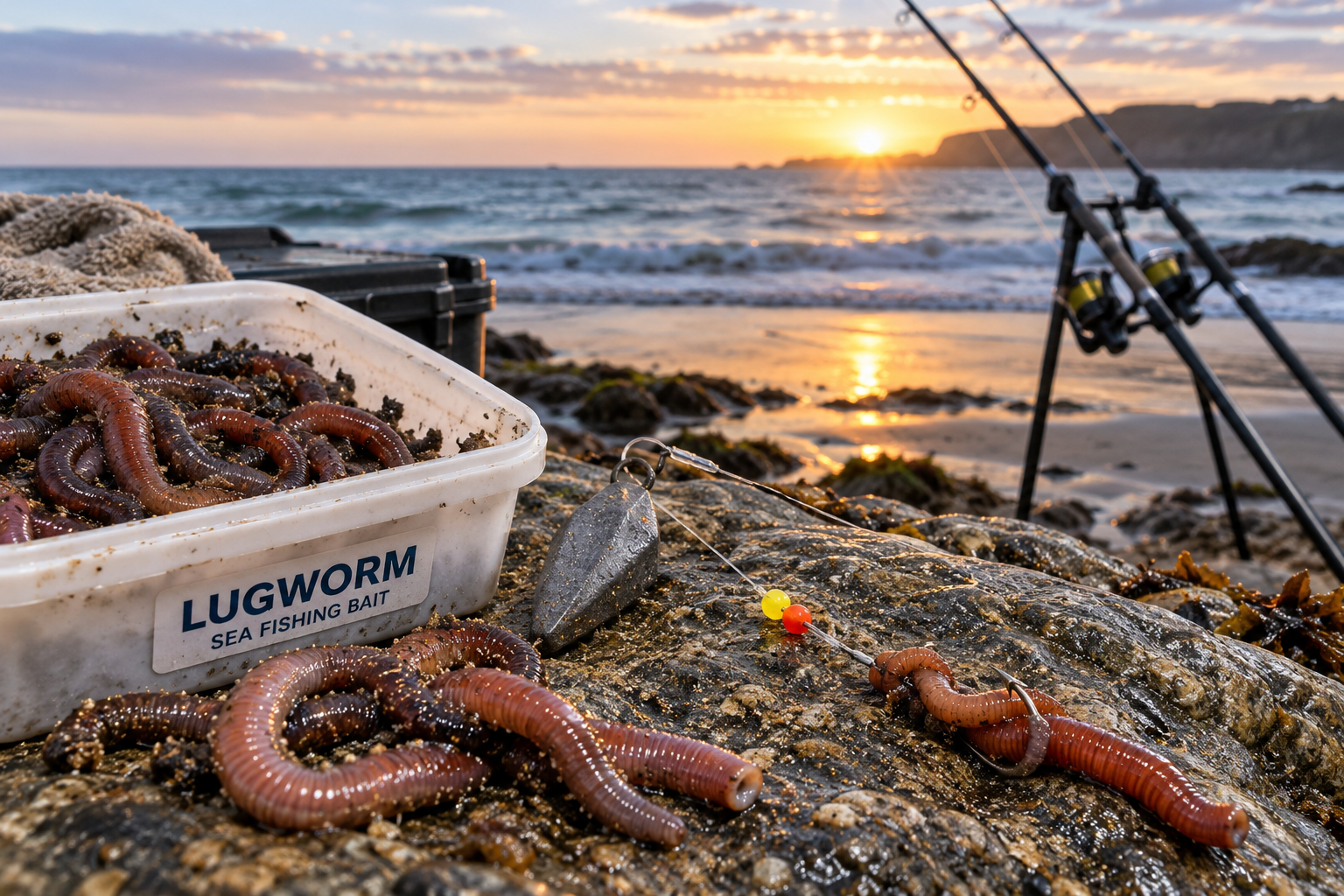
Flatfish shore fishing rigs with coloured beads, micro spoons, hooks and leads displayed on rocks beside two flatfish at sunset.

Some links in this guide are affiliate links. If you buy through them we may earn a small commission at no extra cost to you — it never influences what we recommend.
Flatfish are some of the most accessible species for UK shore anglers, with flounder, plaice and dabs all regularly caught from beaches, estuaries and harbour marks. Although you can catch them on very simple tackle, choosing a rig that suits the ground, tide and casting distance can make a noticeable difference.

Flatfish spend much of their time feeding directly on the seabed, searching for worms, small crustaceans, shellfish and other food, so most successful rigs are designed to keep the bait close to the bottom. Movement and visual attraction can also be particularly effective, which is why beads, sequins and small spoons feature heavily in flatfish fishing.

There isn't one rig that's best for every situation. A running rig can provide excellent bite detection at short range, while a clipped or pulley-style arrangement is better suited to stronger tides, rougher ground or longer casts. These five rigs cover most of the situations a shore angler is likely to encounter.
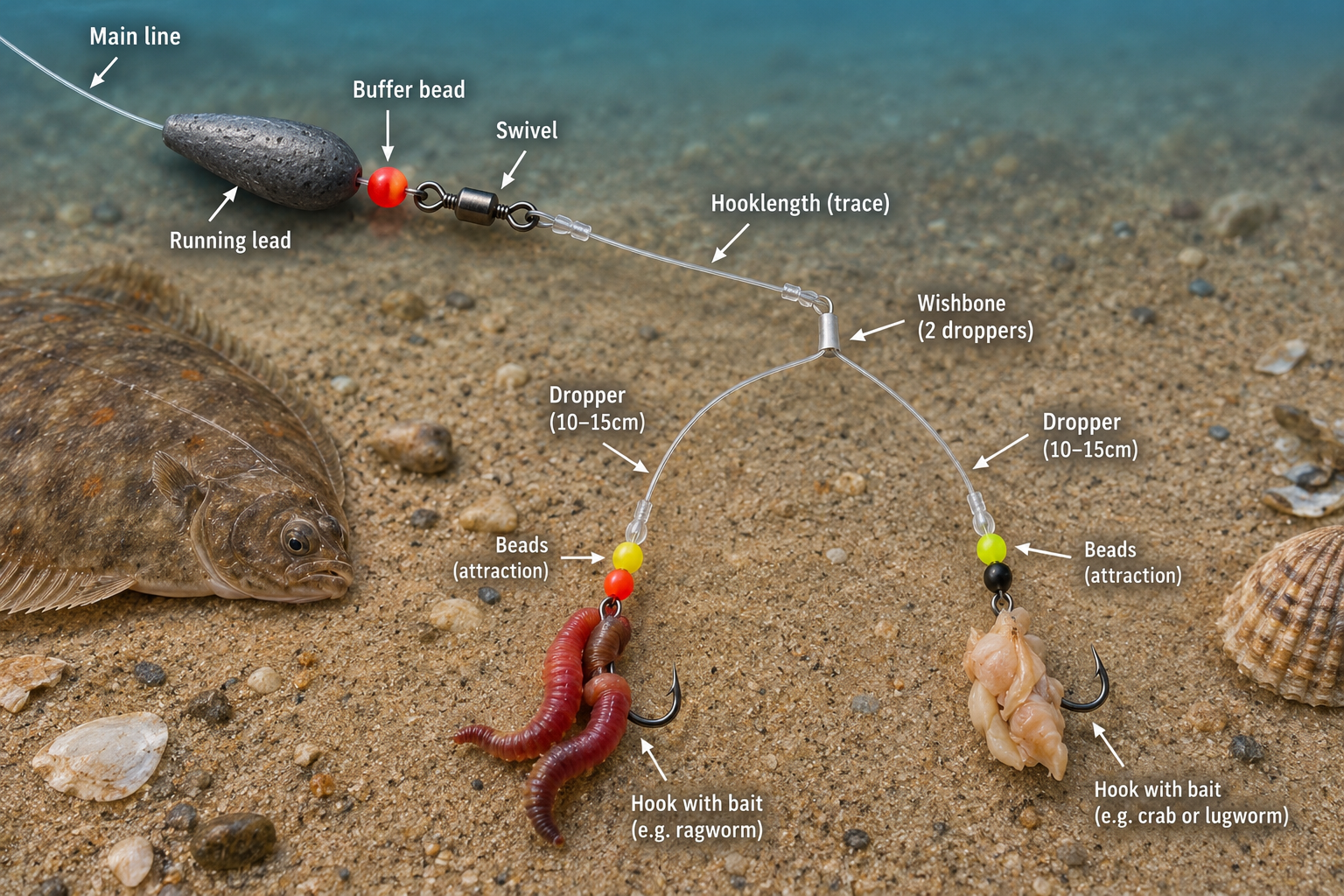
Running wishbone flatfish rig with two baited hooks, coloured beads, short droppers, swivel, buffer bead and running lead on the seabed.
A running wishbone rig for flatfish, using two baited hooks with coloured attraction beads and a free-running lead.
Advertisement
Total Fishing Tackle

Tackle worth buying

Shop rods, reels, terminal tackle and more at Total Fishing Tackle.

Shop Fishing Tackle

Running Wishbone Rig

The running wishbone is one of my favourite rigs when targeting flatfish over relatively clean ground. It combines the sensitivity of a running ledger with two hook baits fishing close together on the seabed. The main line runs through a suitable lead link or swivel before connecting to the hooklength. Towards the end of the hooklength, the trace divides into two shorter hooklengths, creating the characteristic wishbone shape.

The advantage is that two baits can be presented within a relatively small feeding area. You could fish ragworm on one hook and lugworm, crab or a strip of fish on the other, allowing the fish to show you what they prefer. Adding a few coloured beads above each hook provides extra attraction, particularly for plaice. Small floating beads can also be useful where crabs are troublesome, although you don't want to lift the bait too far away from the seabed.

Because the lead is running, a fish can move the hooklength without immediately pulling against the full resistance of the weight. This makes the rig particularly useful when fishing relatively close to shore in estuaries, sheltered beaches and areas with a moderate tide. The downside is that two hooklengths can tangle during a powerful cast, so keeping the wishbone section relatively short and tidy helps considerably.
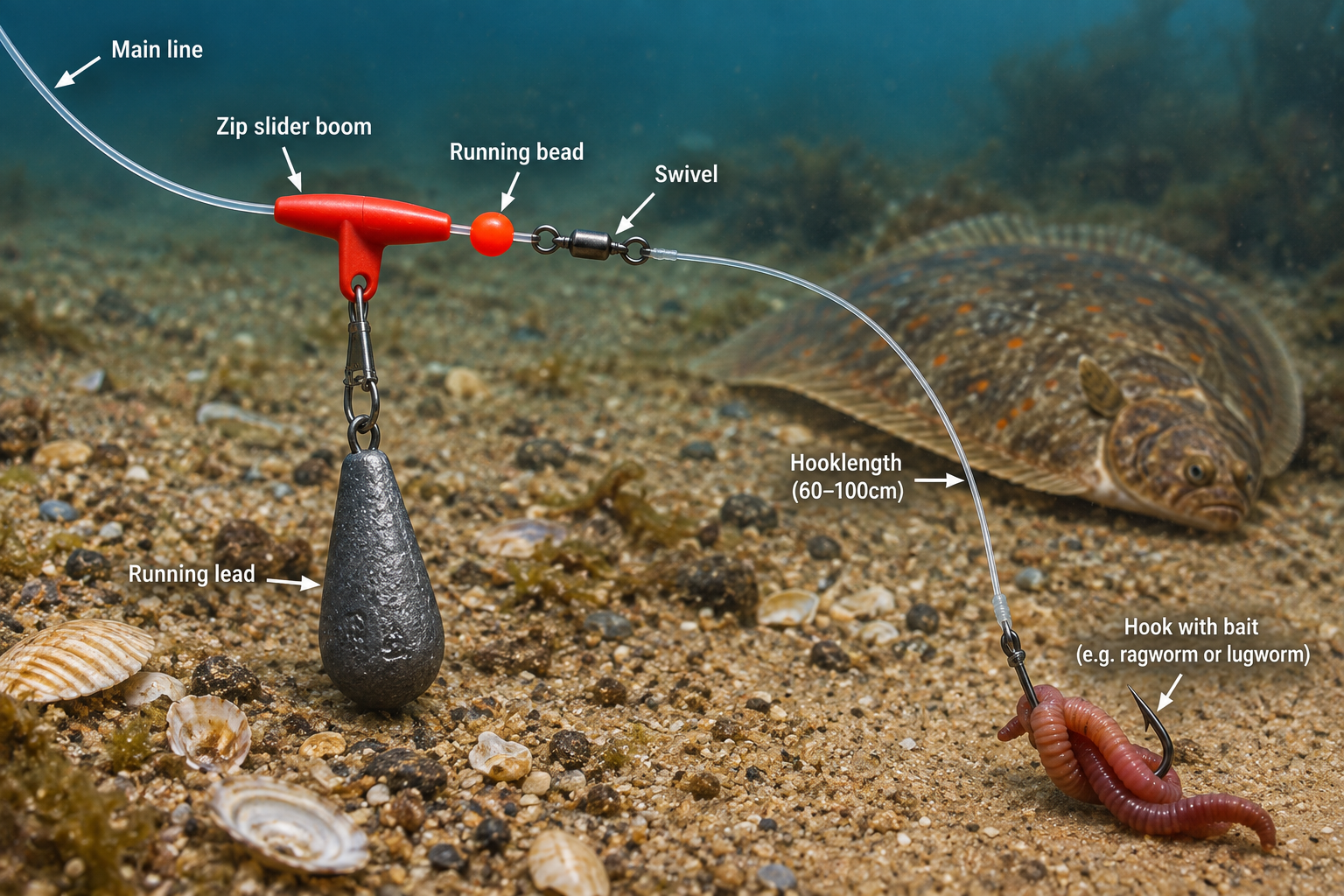
Running ledger rig for flatfish with a zip slider boom, lead weight, running bead, swivel and long hooklength baited with ragworm.
A standard running ledger rig using a zip slider boom, running lead and long hooklength baited with ragworm.

Standard Running Ledger

Sometimes the simplest rig is all you need. A standard running ledger consists of a lead running freely on the main line or leader, followed by a bead to protect the knot, a swivel and a single hooklength. It's easy to construct, inexpensive and extremely effective for flounder, plaice and dabs.

Its biggest strength is natural presentation. Once the lead has settled, the hooklength is free to move with the current, allowing a worm or crab bait to behave naturally along the seabed. A long hooklength can be particularly effective in relatively gentle conditions because the bait has plenty of movement. In stronger tides, shortening the trace can make the rig easier to control.

Running ledgers are particularly good for fishing estuaries and surf beaches where extreme casting distance isn't necessary. You can also slowly retrieve the rig a few metres at a time. This moves the bait across fresh ground and creates small clouds of disturbed sand, potentially attracting inquisitive flatfish. Adding a handful of beads near the hook can give the rig additional visual appeal without making it unnecessarily complicated.

The simplicity of a single hook also makes this a good rig for beginners. There are fewer components to tangle, bait presentation is easy to check and unhooking fish is straightforward.
BZS

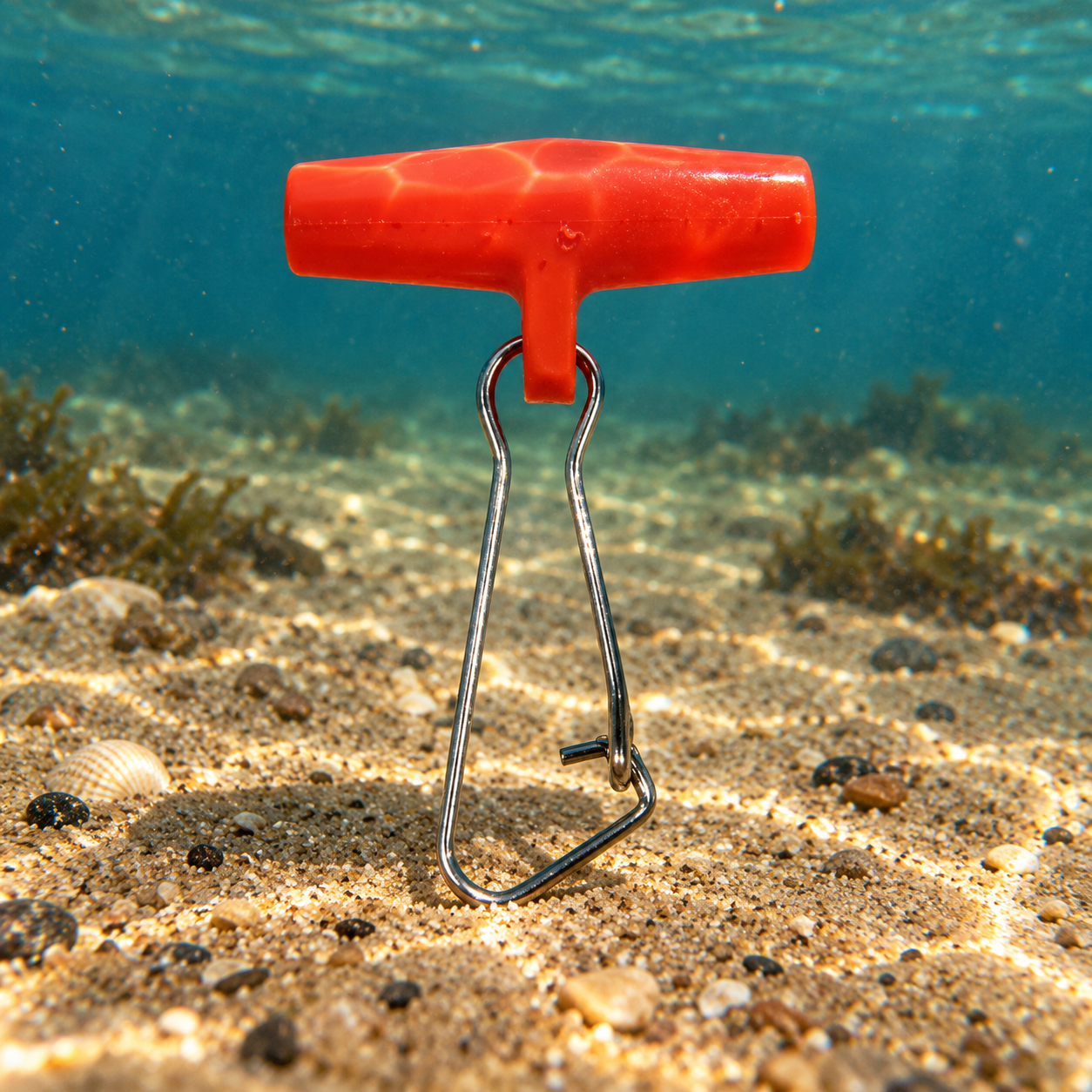
Heavy Duty Red Zip Sinker Sliders/Booms with Strong Steel Clip - Boat Sea Fishing Rigs Tackle Accessories - Available in 20x

Heavy-duty red zip sinker slider designed to let the lead run freely on the main line. The strong metal clip makes it quick and easy to attach or change sinkers while fishing.

Best for: Running ledger rigs, boat fishing and drift fishing for plaice and other flatfish.

89/100Our verdict score

Prices checked 6 Sept 2026. We may earn a commission if you buy through these links — it never changes what we recommend.
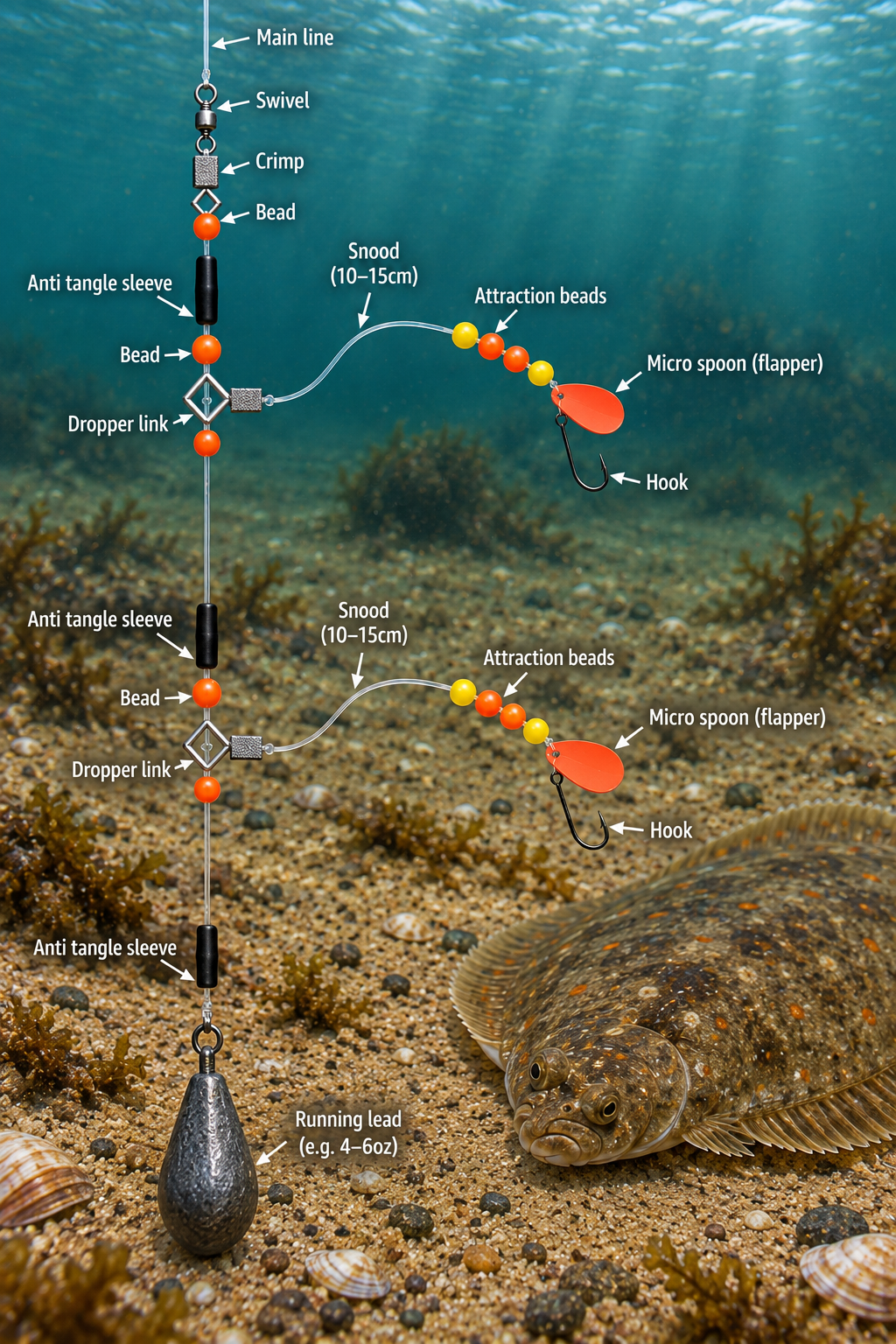
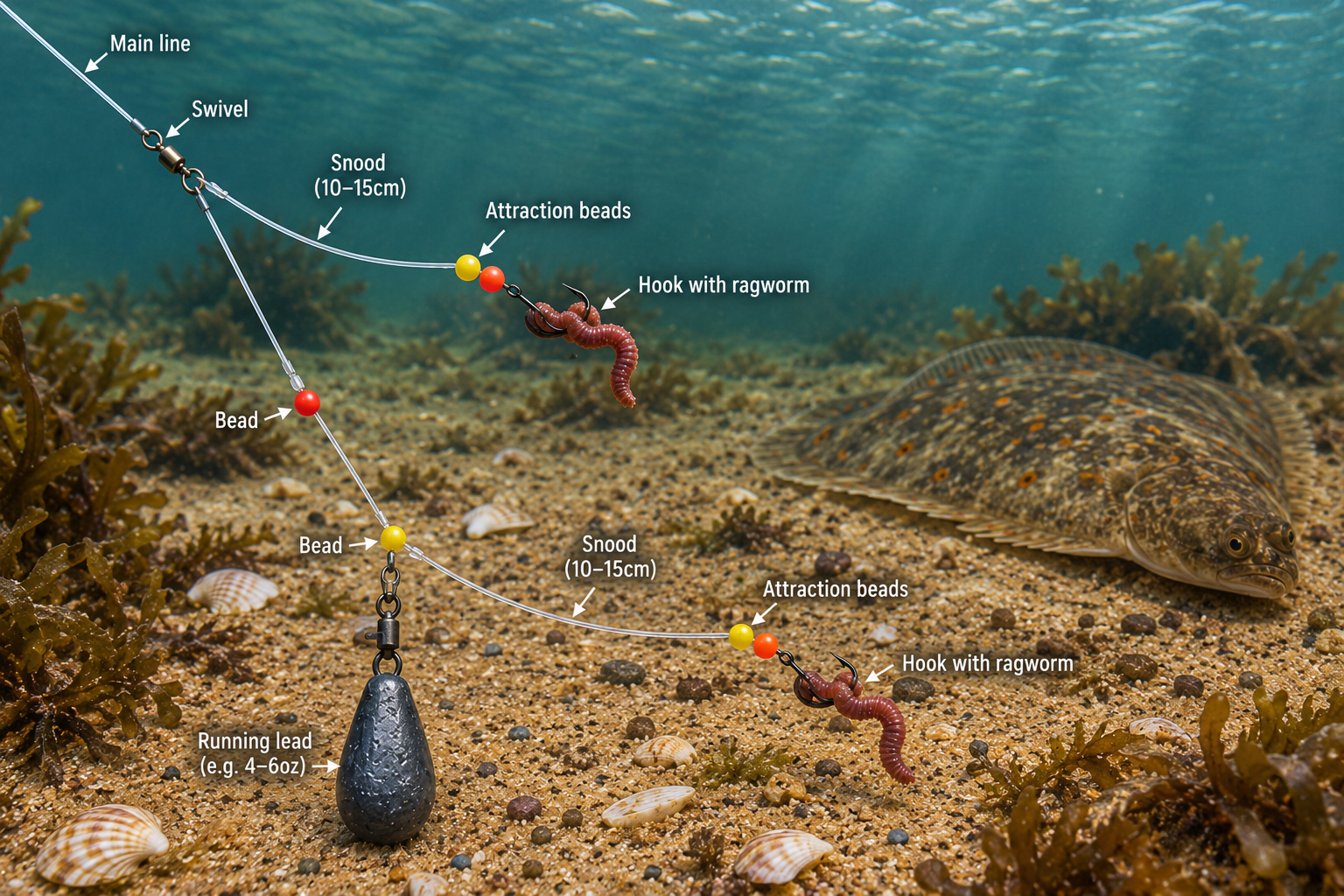
Two-hook flatfish rig with red and yellow beads, micro spoons, two hooks and a lead weight shown underwater beside a flounder.
A two-hook flatfish rig fitted with coloured attraction beads and micro spoons, with a lead weight attached at the bottom.

Two-Hook Flatfish Rig with Beads and Micro Spoons (The Flattie Flapper)
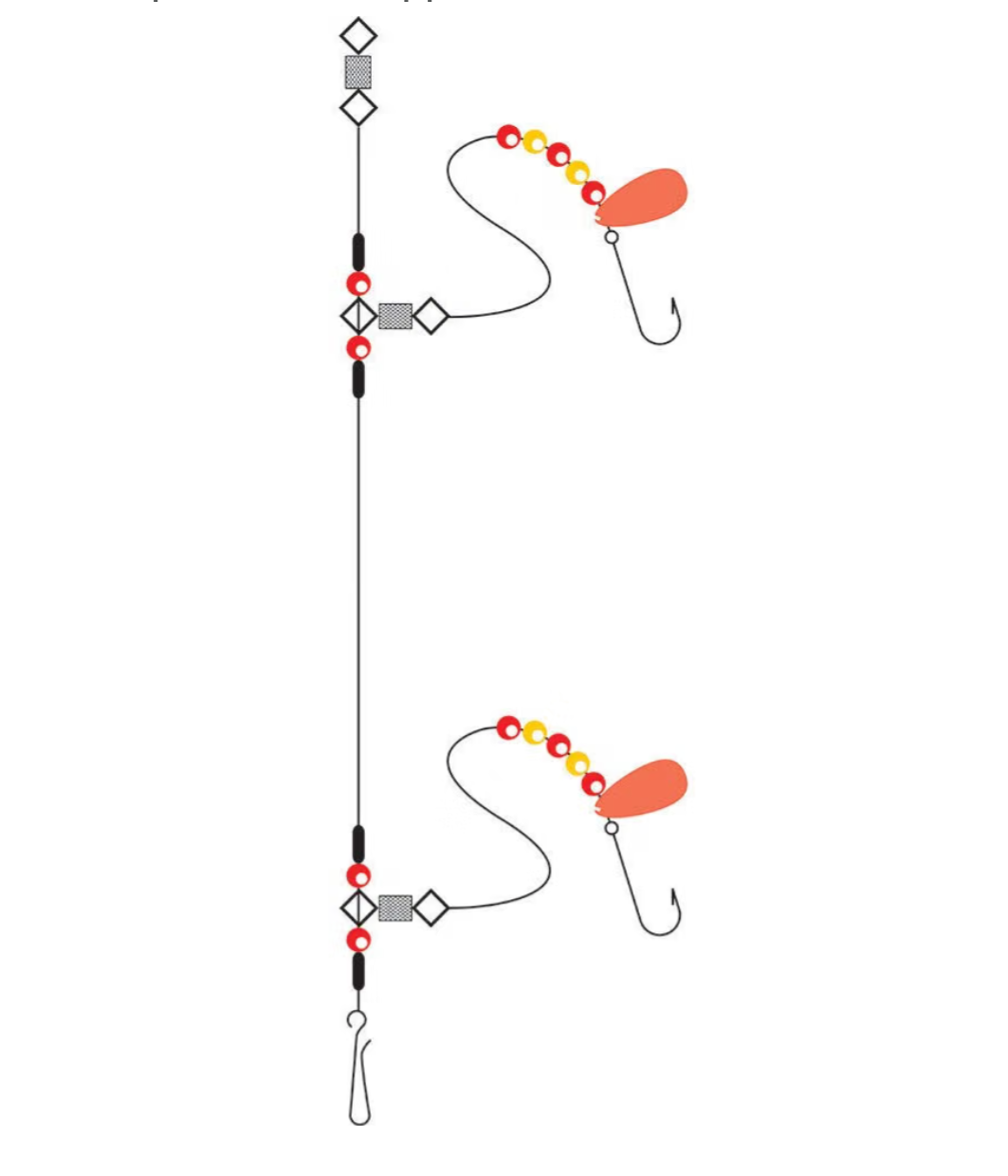
A two-hook rig is a versatile option when you want to search slightly different areas of the seabed or experiment with different baits. The basic arrangement uses a rig body with two short hooklengths attached using swivels or trapped between beads and crimps. A lead is attached at the bottom, keeping both baits close to the seabed.

Where this rig becomes particularly interesting for flatfish is the addition of coloured beads and micro spoons. Plaice especially are well known for responding to visual attraction. Red, yellow, orange, black and luminous beads are all commonly used, while a tiny spoon adds flash and movement as the tide moves the hooklength.

Don't overload the rig. A few carefully chosen attractors immediately above the hook are normally sufficient. Too many beads can make the trace cumbersome and potentially affect casting and bait presentation. Small spoons should also be light enough to flutter rather than overpower the hooklength.

A two-hook rig allows you to experiment. One hook might carry ragworm tipped with squid while the second has lugworm, for example. You can also use different bead combinations on each trace. Over a session, this can reveal whether the fish are showing a preference for a particular bait or colour. It is a particularly useful general-purpose flatfish rig for clean beaches where flounder, dabs and plaice may all be present.
Tronixpro

Flattie Flapper, 2

A ready-made two-hook flapper rig designed for targeting plaice, flounder and other flatfish. Features bright visual attractors around the hook lengths to help draw fish towards the bait when fishing over sand, shingle and mixed ground.

Best for: Plaice, flounder and other flatfish from the shore or boat.

90/100Our verdict score

Prices checked 7 Sept 2026. We may earn a commission if you buy through these links — it never changes what we recommend.
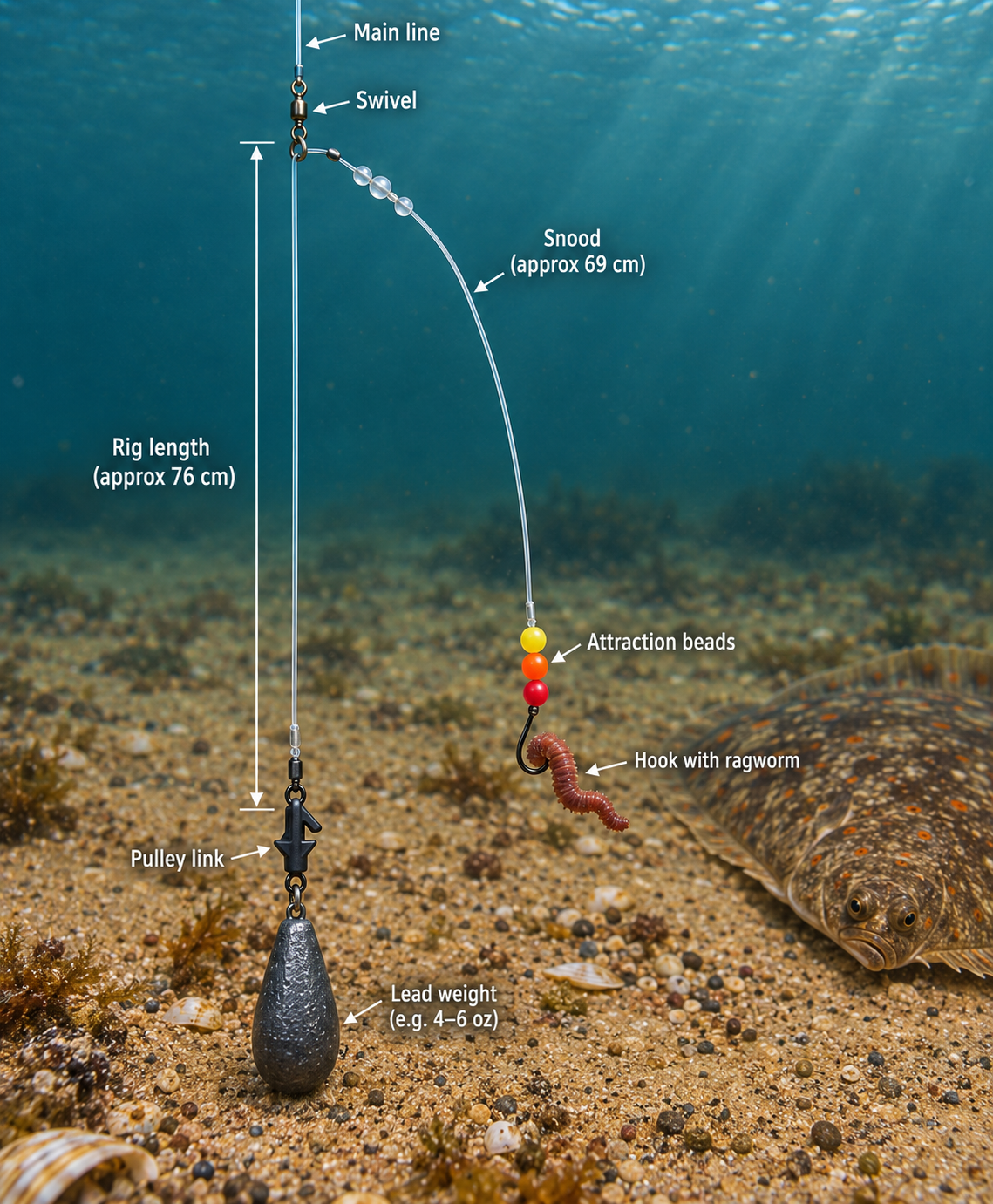
Flatfish pulley rig with coloured beads, ragworm-baited hook, pulley link and lead weight shown underwater beside a flounder.
A pulley rig adapted for flatfish fishing, with coloured attraction beads, ragworm bait and a lead weight for shore casting.

Pulley Rig with Beads

A pulley rig is normally associated with fishing rougher ground for larger species, but a lighter version can be adapted very effectively for flatfish. Its main advantage is that it provides a streamlined single-hook presentation suitable for longer casts while also helping to lift a hooked fish away from snags during retrieval.

For flatfish fishing, use a relatively long hooklength and add a small selection of beads close to the hook. A small spoon or sequin can also be incorporated if you want additional movement. The bait can then be clipped down for casting using a suitable bait clip, which dramatically improves aerodynamics compared with leaving a long hooklength flapping behind the lead.

This makes the pulley rig useful when the flatfish are feeding beyond normal running-ledger range or when you're fishing around mixed ground where weed, stones or occasional snags make a completely free-running rig less practical. It is also a good choice when using a larger worm bait that needs to survive a powerful cast.

The single-hook design means you sacrifice the ability to experiment with two baits simultaneously, but you gain casting efficiency and a strong, tidy rig. For targeting better plaice at distance, that can be a worthwhile compromise.
Wessex flatfish rig with two hooklengths, red and yellow attraction beads, ragworm baits and lead weight shown over a sandy seabed.
A Wessex rig set up for flatfish fishing, with two ragworm-baited hooks, coloured attraction beads and a lead weight.

Wessex Rig

The Wessex rig is an excellent choice when you want to present two baits differently while still retaining a relatively simple shore rig. It combines elements of a paternoster and flowing trace, normally giving you one hook positioned above the lead and another longer hooklength fishing below or around the lead on the seabed.

This creates two noticeably different presentations. The upper bait has more movement in the tide, while the longer lower trace behaves more like a traditional flowing flatfish rig. It therefore allows you to cover slightly different feeding zones without needing two separate rods.

For flatfish, the lower hooklength can be dressed with coloured beads, sequins or a micro spoon and baited with worm, while the upper hook can carry a different bait or a simpler presentation. Although flatfish are primarily bottom feeders, movement from the upper trace can still attract fish towards the rig.

The Wessex is particularly useful on clean or lightly mixed ground where several species may be present. A flounder or plaice may take the long bottom trace while whiting, pouting or another species finds the upper bait first. This makes it a useful rig when you're not certain exactly what's feeding.

All five rigs will catch flatfish, and there's no need to carry dozens of complicated alternatives. For close-range estuary fishing I'd favour the running ledger or wishbone, while the two-hook attractor rig is a strong general choice for clean beaches. When distance or more difficult ground becomes important, the pulley rig comes into its own, while the Wessex provides an adaptable option when you want two different presentations. More important than the exact rig is keeping the bait close to the seabed, using fresh bait and putting it where the fish are feeding.

The monthly catch-up

One email a month: new guides, tackle worth buying and waters we've fished.

Keep reading

Related guides